


REMARKS TO THE MEDIA (Tokyo, 20 May 2026)
2026.05.21
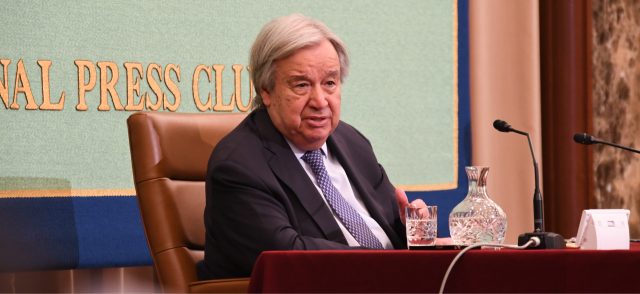
Ladies and gentlemen of the press,
Allow me first of all to pay tribute to the Japanese journalists.
You are a fundamental pillar of freedom of the press and a fundamental pillar of the Japanese democracy.
And indeed, this is my last press conference as Secretary-General in this role.
I want to express how much I appreciate the work of Japanese journalists in today’s world.
Thank you for joining us today.
I am here in Japan on a mission of gratitude and determination.
First — gratitude to the Government and people of Japan for the warm welcome, once again, to this beautiful country.
Two days ago, I had the pleasure of meeting with Her Excellency, Ms. Sanae Takaichi, Prime Minister of Japan.
As I told her, the United Nations is deeply proud of our partnership with Japan.
Since joining the United Nations 70 years ago, this country has been a steadfast and generous champion of multilateralism and the power of collaboration and unity.
The UN System has some 30 offices based in Japan — including the UN University headquartered in Tokyo — a meeting place for global experts on a wide range of critical international issues.
This week, UN leaders from across our system came to Japan for our annual meeting of the Chief Executives Board for Coordination — the first time this meeting has been held in Asia.
Among the people of Japan, we’ve witnessed an enormous generosity in helping the UN operate in some of the world’s most troubled places and support the people of the world with life-saving aid.
Feeding the hungry.
Providing shelter and protection to families in war zones.
Protecting women and girls from violence.
Delivering medical assistance — including during the COVID-19 pandemic.
Supporting vital peacekeeping missions in some of the most dangerous and unstable places in the world.
And promoting the vision of human security Japan has also been a steadfast champion of multilateralism and voice of peace at the United Nations, within the Security Council, and worldwide.
From conflict prevention, to defending the rule of law, to nuclear disarmament, an issue of deep importance to the Japanese people.
I was proud to be the first Secretary-General to attend peace ceremonies in both Nagasaki and Hiroshima and pay tribute to the atomic bomb survivors — hibakusha — whose bravery and message of peace continue to inspire me.
I was also proud to participate in so many of the sessions of the TICAD process — Japan’s extraordinary partnership with Africa over three decades.
TICAD is a prime example of collaboration across regions to spur development, and a reminder that no country walks alone.
Japan’s training of African Union peacekeepers through Triangular Partnership Programme is another clear example, with the Programme celebrating its tenth anniversary last year.
The United Nations supported Japan’s response and recovery efforts to the earthquake in 2011, which devastated the Tohuku region and the city of Sendai — an experience that Japan transformed into global leadership on disaster risk reduction.
I continue to stand by Japan’s call for a resolution of the issue of the abduction of Japanese citizens by the Democratic People’s Republic of Korea — an unacceptable violation of human rights. And I want to express my total solidarity with the abductees and their families.
Our organization was also proud to take part in last year’s Expo 2025 in Osaka.
I had the honour of visiting on the United Nations Special Day.
I saw how the Expo brought people together — across nations, cultures and generations — around a simple truth: humanity is strongest when we stand as one.
This brings me to the second part of my mission.
Determination.
I am determined to ensure a strong UN-Japan partnership for the future.
The true hallmark of partnership is revealed in times of crisis.
And our world today is rocked by conflicts, climate chaos and inequality.
Inflation is rising and the cost-of-living crisis is deepening — made worse by the conflict in the Middle East, which is sending prices for energy and raw materials – including fertilizers -skyrocketing.
It is essential to immediately reestablish the freedom of navigation in and around the Strait of Hormuz, and to end all ceasefire violations and create conditions for a political solution to the conflict.
Mistrust and geopolitical divisions are blocking effective solutions.
Countries are flouting international law with impunity.
Military spending is outpacing spending on aid, while funding cuts have devastating consequences for the world’s most vulnerable people.
The Sustainable Development Goals — our blueprint for a better future for people and planet — require much stronger progress.
Multilateral development banks are not sufficiently supporting developing countries, who are drowning in debt service and facing a lack of financing.
We must recapitalize those multilateral development banks for them to have the necessary resources to support developing countries.
And world-changing technology like Artificial Intelligence is progressing faster than the ability to manage it safely.
The global problem-solving architecture — in particular, the UN Security Council and global financial institutions — are not as effective as they need to be at this challenging moment.
In 2024, Member States adopted the Pact for the Future — a bold vision of reform and renewal of the multilateral system.
And last year, we launched the UN80 Initiative — to ensure that the United Nations is equipped to deliver for people and for planet in these fast-moving times.
With the strong support of Japan, I am convinced we can weather today’s storms and restore global trust in what we can achieve by standing as one.
And by implementing the Sevilla Commitment on Financing for Development agreed last year, to supercharge financing for development while providing new tools for effective debt relief.
But the most important reform that needs to be established is the reform of the UN Security Council whose composition does not guarantee the legitimacy and effectiveness that obviously are dramatically affected by the fact that the permanent members have three European [countries], one Asian [country] – when Asia today have at least half of the world’s population – one North American but no African nor Latin American [countries].
This is a serious problem of legitimacy and of ineffectiveness, and it is absolutely essential to increase the number of Permanent Members and to increase the number of non-Permanent Members to make the Security council corresponds to today’s world, to the realities of today’s world.
And also, we need to reform the global financial architecture to give far greater representation of developing countries in addressing today’s challenges.
We need a multilateral system that is more fair, more able to continue to defend international law and hold countries accountable to it.
Able to take bold action on climate change, supercharging the transition to renewable energy — with speed and with justice for developing countries through support for adaptation.
Able to bring governments and technology companies together to ensure Artificial Intelligence helps, not hinders, humanity.
And to work to scale-up the funding required to save lives, and build peaceful and resilient communities around the world.
Across all of these issues, Japan can be a strong and influential voice of unity and purpose, as we navigate these headwinds.
Ladies and gentlemen of the media,
The United Nations remains the essential, one-of-a-kind meeting ground to advance peace, sustainable development and human rights.
Eight decades after our founding, we can draw a direct line between the creation of the UN and the prevention of a third world war.
But our organization is only as strong as Member States’ commitment to it.
For 70 years, the goals of Japan and the goals of the United Nations have been strongly aligned.
Across the decades, the UN has benefitted enormously from Japan’s generosity and commitment to the multilateral system.
And Japan has successfully leveraged its role at the United Nations to grow its diplomatic influence, and build economic prosperity and peace through a stable and cooperative global system.
Once again, I thank the Government and people of Japan for the warm welcome, and for our extraordinary partnership over the last 70 years.
*****